Buildings vs. Units: Where Condo Risk Actually Lives When Buying a Condo in Myrtle Beach
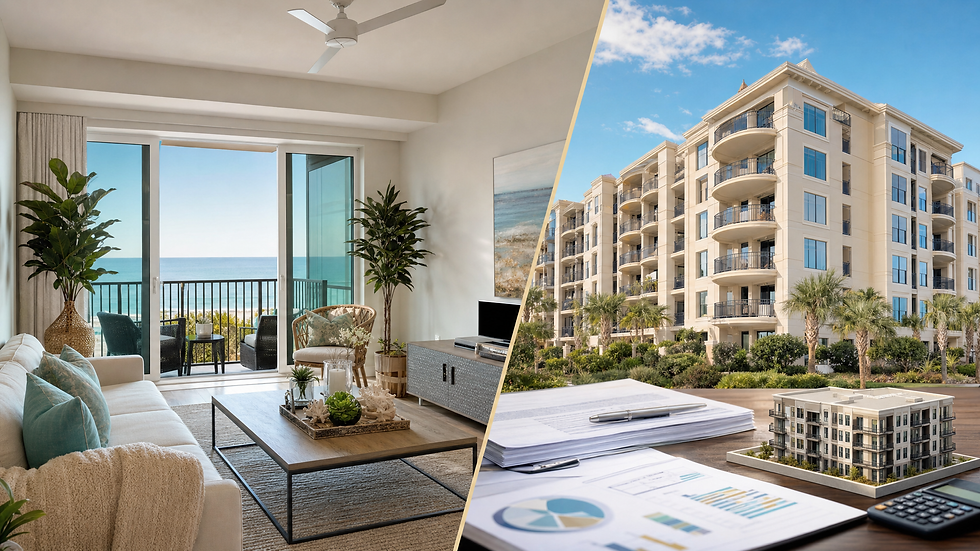
If you're considering buying a condo in Myrtle Beach or anywhere along the Grand
Strand, it's natural to focus on the unit itself.
The view. The floor plan. The updates. The condition of the kitchen and bathrooms.
Those details matter.
But one of the most important aspects of condo ownership often isn't inside the unit at all.
It's at the building level.
Understanding the difference between unit-level and building-level considerations can help buyers make more informed decisions, avoid surprises during due diligence, and gain greater confidence throughout the purchase process.
Let me explain this simply.
Most Buyers Naturally Start With the Unit
The unit is what you walk through during a showing.
It's what you imagine using day to day.
It's what you compare against other Myrtle Beach condos for sale.
You notice whether the flooring has been updated. You evaluate the layout. You decide whether the balcony fits how you want to spend your time.
Because the unit is what buyers experience firsthand, it's easy to focus almost entirely on its condition.
However, condo ownership extends beyond the walls of an individual residence.
A beautifully renovated condo can exist within a building that has deferred maintenance, financial challenges, or insurance concerns.
At the same time, a unit that needs cosmetic updates may be part of a well-managed community with strong reserves, predictable expenses, and long-term stability.
In many cases, the building tells a larger story than the finishes.
A Condo Purchase Is Really Two Separate Decisions
Unlike a single-family home purchase, buying a condo involves evaluating two distinct components.
First, you're evaluating the individual unit.
Second, you're evaluating the condominium association and the building that support it.
Many buyers devote most of their attention to the first decision while spending very little time on the second.
Yet the second decision often has a significant influence on the ownership experience over time.
Building-level factors can affect:
Future maintenance costs
HOA financial stability
Insurance requirements
Financing eligibility
Reserve funding
Potential special assessments
Ease of ownership
Long-term flexibility
These aren't necessarily problems or warning signs.
They're simply important parts of understanding how a condo functions beyond the residence itself.
Why Building-Level Risk Often Surprises Buyers
One of the most common surprises occurs when a condo unit appears excellent, but questions arise during financing, insurance review, or due diligence.
The unit may be perfectly maintained.
The concerns may have nothing to do with the interior.
Instead, lenders, insurers, and buyers may be evaluating factors such as:
Deferred maintenance
Reserve fund balances
Ongoing litigation
Structural repair projects
Association financial health
Owner-occupancy ratios
Insurance coverage details
None of these items are visible while standing in the living room.
Yet they can influence financing approval, ownership costs, and the overall transaction.
This is one reason condo purchases in Myrtle Beach often require a broader review than buyers initially expect.
Condo Financing Often Starts With the Building
Many buyers assume lenders are evaluating only the borrower's finances.
That's certainly part of the process.
However, condo financing frequently includes a review of the condominium project itself.
The building matters.
Depending on the loan program, lenders may review:
Association financial stability
Insurance coverage
Owner-occupancy ratios
Delinquency rates
Litigation status
Reserve funding levels
This is particularly relevant throughout the Grand Strand, where condominiums make up a substantial portion of the available housing inventory.
A condo may appear to be an ideal fit, but financing approval can sometimes depend on factors occurring at the project level rather than within the unit.
Buyers who understand this early often approach the search process with greater clarity because they know which questions to ask before moving forward.
Maintenance Is Often a Building Story

Another area where building-level considerations become important is maintenance.
A newly updated condo may feel move-in ready today.
Thoughtful buyers usually take the next step and evaluate the condition of the building itself.
Questions worth exploring include:
Has the roof been replaced recently?
Are major systems nearing replacement?
Are common areas maintained consistently?
Is the association proactive with repairs?
Have significant projects been deferred?
In most cases, deferred maintenance doesn't appear as one dramatic problem.
It develops gradually over time.
Repairs are postponed. Common areas age. Larger projects begin to accumulate.
Eventually, these decisions can influence ownership costs and overall building performance.
The goal isn't to avoid older condo communities.
Many established Grand Strand condominium developments are exceptionally well managed.
The goal is simply understanding how the property is being maintained over time.
Insurance Plays a Larger Role Than Many Buyers Expect
Insurance has become an increasingly important part of condo ownership conversations, particularly in coastal markets like Myrtle Beach.
Most buyers think about insuring their personal belongings and the interior of their unit.
That's important.
At the same time, the association's master insurance policy can have a significant impact on ownership.
Building-level insurance affects:
HOA budgets
Monthly ownership costs
Future assessment considerations
Lender requirements
Overall financial stability
Buyers don't need to become insurance experts.
However, understanding that some of the most important insurance considerations exist at the building level can help create greater decision clarity throughout the process.
HOA Fees Tell a Bigger Story

A common misconception is that HOA fees should be judged solely by the monthly amount.
In reality, HOA fees often provide insight into how a condominium community operates.
The fee itself is only one piece of the puzzle.
Questions worth considering include:
What services are included?
How are funds allocated?
Are reserve accounts being funded appropriately?
Is maintenance being handled proactively?
How does the budget support long-term building needs?
Some buyers focus primarily on finding the lowest HOA fee available.
Others focus on understanding what that fee provides.
Those are very different approaches.
A lower fee may reflect operational efficiency.
In other situations, it may indicate future projects that have not yet been fully funded.
The number alone rarely tells the entire story.
Unit-Level vs. Building-Level Considerations
When evaluating a Myrtle Beach condo, it can be helpful to separate considerations into two categories.
Unit-Level Considerations
Interior condition
Appliances
Flooring
Layout
Renovations
Views
Day-to-day functionality
Building-Level Considerations
Financial health
Reserve funding
Insurance structure
Maintenance history
Structural condition
Association management
Financing eligibility
Both matter.
The key is recognizing that they're different conversations.
Many buyers naturally focus on what they can see.
The less visible factors often require additional review, but they frequently have a greater influence on the long-term ownership experience.
What This Means for Myrtle Beach and Grand Strand Buyers

The Grand Strand offers a wide variety of condo ownership opportunities.
Buyers can choose from:
Oceanfront condo towers
Resort-style communities
Golf course condominiums
Boutique buildings
Townhome-style condominiums
Second-home communities
Each property type comes with its own ownership structure, management style, insurance considerations, and financial framework.
Because of that variety, two condos with similar price points can offer very different ownership experiences.
The differences are not always visible inside the units.
They're often found in how the building operates behind the scenes.
Buyers who understand this tend to evaluate properties differently.
They look beyond cosmetic finishes.
They ask broader questions.
They consider how the property will function over time, not just how it looks today.
For buyers who value ease of ownership, predictable expenses, and long-term flexibility, that perspective can be especially valuable.
Putting It All Together
When buying a condo in Myrtle Beach, the unit matters.
The building matters too.
In many cases, the most important long-term ownership considerations live at the building level rather than inside the residence itself.
That doesn't mean condos are inherently risky.
It simply means the evaluation process is broader than many buyers expect.
The goal isn't to become an expert in reserve studies, insurance policies, or association financial statements.
The goal is understanding where the important questions live so you can make informed decisions with confidence.
A condo purchase is never just about the unit.
It's also about the building supporting it.
Once buyers understand that distinction, the process often becomes much clearer.
Frequently Asked Questions About Buying a Condo in Myrtle Beach
What should I look at besides the condo unit itself?
Buyers should review the association's financial health, reserve funding, insurance coverage, maintenance history, and overall building condition in addition to evaluating the unit.
Can a condo building affect financing approval?
Yes. Many lenders evaluate the condominium project itself, including insurance coverage, reserve funding, occupancy ratios, and financial stability.
Are HOA fees a sign of whether a condo is a good investment?
Not necessarily. HOA fees should be evaluated based on what they cover, how reserves are funded, and whether the association is maintaining the property effectively.
Why are reserves important in a condo association?
Reserve funds help cover future repairs and capital improvements. Well-funded reserves can contribute to more predictable ownership costs over time.
A Simple Next Step
If you're considering a condo in Myrtle Beach or anywhere along the Grand Strand and would like help evaluating both the unit and the building behind it, I'm always happy to walk through the differences with you.
Sometimes a short conversation is all it takes to identify the questions that matter most before moving forward.
Century 21 The Harrelson Group
Main Office: 843-903-3550
Direct Office: 843-975-2335
Mobile: 843-429-1578
Email: lmendieta@c21harrelson.com


Comments