Condo HOA vs. Single-Family Home Ownership in Myrtle Beach: How Buyers Decide Which Option Fits Best

If you're planning to buy a home in Myrtle Beach or anywhere along the Grand Strand, one of the first decisions you'll face is whether a condo or a single-family home makes more sense for your goals.
Many buyers begin by comparing square footage, price, or location. Those factors matter, of course. But where buyers are often surprised is that the ownership experience itself can be very different.
The question isn't simply, "Which property is better?"
The better question is:
Which ownership structure aligns best with how you want to spend your time, manage responsibilities, and use the property over the long term?
Let me explain this simply.
Condo vs. Single-Family Home: The Decision Is About Ownership, Not Just Real Estate
At first glance, a condo and a single-family home can offer many of the same benefits.
Both can provide access to desirable Myrtle Beach locations. Both can serve as primary residences, second homes, vacation homes, or investment properties. Both can be excellent options depending on the buyer.
The difference is how ownership functions after closing.
In practice, buyers are not only purchasing a property. They're choosing a system of responsibilities, costs, rules, maintenance expectations, and long-term ownership considerations that will continue long after move-in day.
Understanding those differences upfront creates much more decision clarity.
What Condo Ownership Means in Myrtle Beach

When you purchase a condo, you typically own the interior space of your unit while sharing ownership of common areas with other owners in the community.
Those shared areas often include:
Building exteriors
Roofs
Elevators
Pools
Fitness centers
Parking areas
Landscaping
Hallways and common spaces
To maintain those shared elements, owners pay condominium association or HOA fees.
For many buyers, the appeal is straightforward.
A significant portion of exterior maintenance and community upkeep is coordinated through the association. This can create greater day-to-day simplicity, particularly for second-home owners, seasonal residents, and buyers who prefer a more lock-and-leave ownership experience.
That doesn't mean condo ownership is "easier."
It means the responsibilities are distributed differently.
Benefits of Condo Ownership
Many buyers choose a Myrtle Beach condo because they value:
Ease of ownership
Shared maintenance responsibilities
Resort-style amenities
Predictable maintenance coordination
Flexibility for part-time residency
Reduced exterior upkeep
What Single-Family Home Ownership Means
With a single-family home, ownership is typically more direct.
You generally own the structure, the land, and the responsibility that comes with both.
That often includes:
Roof maintenance
Exterior repairs
Landscaping
Irrigation systems
Driveways
Fencing
Pest management
Ongoing property upkeep
Some Myrtle Beach communities have HOAs as well, but the scope is often different than a condominium association.
Buyers who prefer greater control over their property often appreciate this ownership style. At the same time, that control usually comes with additional decisions and responsibilities over time.
Neither approach is right or wrong.
They're simply different.
Benefits of Single-Family Home Ownership
Buyers often prefer a single-family home because of:
Greater privacy
More outdoor space
Flexibility for customization
Direct control over maintenance decisions
Fewer shared common areas
Potential for larger lots and yards
HOA Fees vs. Home Maintenance: The Trade-Off Most Buyers Don't Consider

Many buyers initially focus on HOA fees.
That's understandable.
But thoughtful buyers often look one step further.
The more important question is what those fees are replacing.
For example, a condo owner may pay higher monthly association dues but avoid budgeting separately for:
Roof replacement
Exterior painting
Landscaping
Pool maintenance
Building upkeep
Common-area repairs
A single-family homeowner may have lower recurring fees but assumes responsibility for those expenses as they arise.
Where buyers are most often surprised is that comparing HOA fees alone rarely tells the full story.
The real comparison is total ownership responsibility.
How Lifestyle Factors Into the Condo vs. House Decision
Lifestyle is often discussed in broad terms.
In reality, the better approach is to look at how ownership affects your time.
For buyers who value ease of ownership and predictable maintenance responsibilities, condos often become attractive.
For buyers who enjoy managing their property, gardening, customizing outdoor spaces, or having additional privacy, a single-family home may align more naturally.
Neither choice is inherently better.
It depends on how you want the property to function in your daily life.
Some buyers prioritize flexibility when they're traveling frequently.
Others prioritize having complete control over their property.
The ownership structure should support those priorities rather than work against them.
Myrtle Beach and Grand Strand Considerations
This decision becomes even more important in coastal markets like Myrtle Beach and the Grand Strand.
Coastal ownership introduces additional factors that buyers from other areas may not immediately anticipate.
These can include:
Wind and storm exposure
Insurance considerations
Exterior maintenance requirements
Community infrastructure
Flood zone considerations
Shared building systems
For condo owners, many of these responsibilities may be coordinated through the association.
For single-family homeowners, those responsibilities often remain directly with the owner.
This doesn't make one option safer or smarter than the other.
It simply changes how those responsibilities are managed.
Understanding that distinction early helps buyers evaluate properties more realistically.
Condo Financing vs. Single-Family Home Financing
Another area where property type matters more than many buyers expect is financing.
Condominiums often require lenders to review not only the buyer's qualifications but also aspects of the condominium project itself.
Depending on the building, lenders may evaluate:
Financial reserves
Insurance coverage
Owner-occupancy ratios
Pending litigation
Project eligibility requirements
In practice, this usually isn't something buyers need to manage independently. However, it can influence financing options and timelines.
Single-family homes typically involve fewer project-level reviews because the lender is primarily evaluating the property and the buyer.
This is one reason property type should be discussed early in the search process rather than after a contract is signed.
Think Beyond Today: Long-Term Ownership Flexibility
Many buyers focus heavily on how they'll use the property today.
A useful exercise is considering how you'll use it five or ten years from now.
Questions worth considering include:
Will the property eventually become a second home?
Could it become a retirement residence?
Might you use it seasonally?
Will maintenance responsibilities feel different later than they do today?
Could rental flexibility become important in the future?
Thoughtful buyers often discover that the best decision isn't based on their current situation alone.
It's based on how the property functions across multiple stages of ownership.
Common Misconceptions About Condos and Single-Family Homes
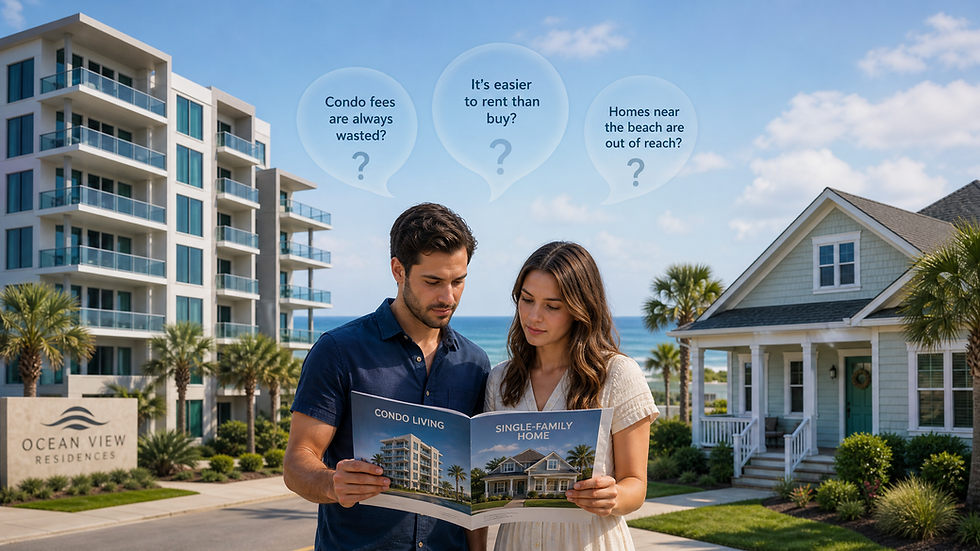
"Condo Ownership Means No Maintenance"
Not exactly.
Maintenance still exists.
The difference is that much of it is coordinated collectively through the association rather than managed individually.
"Single-Family Homes Are Always Less Expensive"
Not necessarily.
Comparing HOA dues to a mortgage payment alone rarely provides an accurate picture.
Long-term maintenance costs, insurance expenses, repairs, and upkeep all contribute to total ownership costs.
"All HOAs Operate the Same Way"
They don't.
Association structures, budgets, rules, reserves, and responsibilities can vary significantly from one community to another.
Reviewing governing documents and understanding how the association functions is an important part of the evaluation process.
Is a Condo or Single-Family Home Better in Myrtle Beach?
The answer depends entirely on your priorities.
For some buyers, ease of ownership, predictable maintenance coordination, amenities, and lock-and-leave flexibility make a condo an excellent fit.
For others, privacy, customization opportunities, outdoor space, and direct control over the property make single-family ownership the stronger option.
The goal isn't to choose the option that someone else prefers.
The goal is to choose the ownership structure that aligns with how you want the property to function over time.
When buyers understand the trade-offs clearly, the decision usually becomes much easier.
Final Thoughts
Condo ownership and single-family home ownership can both work exceptionally well in the Myrtle Beach and Grand Strand market.
The key is understanding that you're not simply choosing a property type.
You're choosing an ownership experience.
The buyers who feel most confident in their decision are usually the ones who evaluate not only location and price, but also maintenance responsibilities, long-term flexibility, financing considerations, and day-to-day ownership realities.
That level of clarity tends to create better decisions from the very beginning.
A Simple Next Step

If you're weighing condo ownership versus a single-family home and want to understand how the differences apply to your specific goals, I'm always happy to walk through the options with you.
Sometimes a short conversation is all it takes to identify which ownership style aligns best with how you plan to use the property, both now and in the years ahead.


Comments